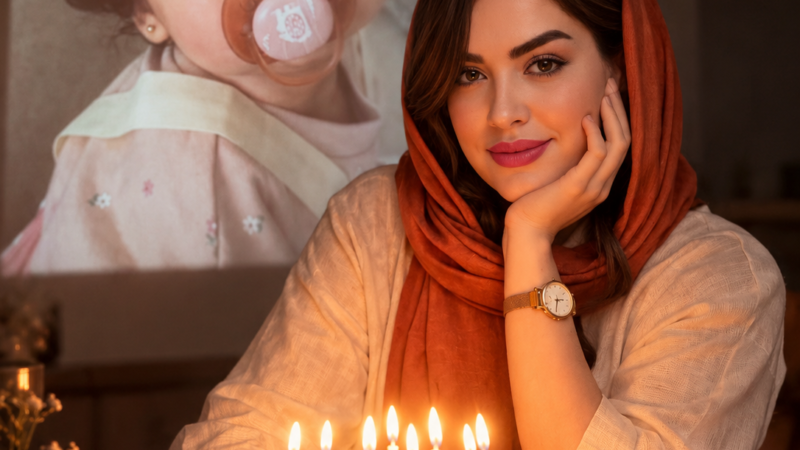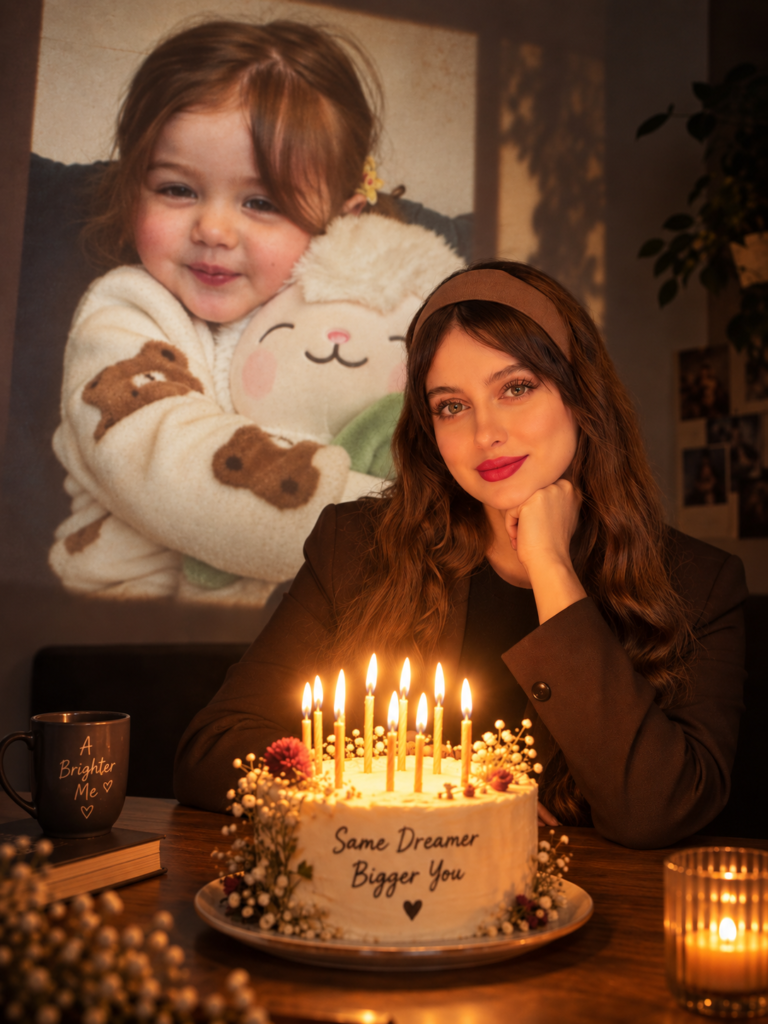
CREATE A CINEMATIC BIRTHDAY PORTRAIT USING TWO UPLOADED REFERENCE IMAGES.
REFERENCE IMAGE 1 = CURRENT PHOTO
This is the PRIMARY IDENTITY REFERENCE for the adult subject.
REFERENCE IMAGE 2 = CHILDHOOD PHOTO
This is the CHILDHOOD PROJECTION SOURCE and must appear as a large projected photograph on the wall behind the adult subject.
The concept is a deeply nostalgic birthday portrait: the person in the present day sits in a dark, intimate room in front of a birthday cake illuminated by candles, while a large photograph of their younger childhood self is projected onto the wall behind them.
==================================================
1. CURRENT SUBJECT — ABSOLUTE IDENTITY PRESERVATION
==================================================
Use REFERENCE IMAGE 1 as the authoritative source for the present-day person.
The person in the final image must remain the exact same recognizable individual shown in REFERENCE IMAGE 1.
Preserve as faithfully as possible:
- exact facial structure
- facial proportions
- eye shape and spacing
- eyebrows
- nose
- lips
- jawline
- cheeks
- skin tone
- natural skin texture
- natural facial asymmetry
- apparent age
- hairstyle and hair characteristics
- body proportions
- distinctive visible features
Do NOT beautify or idealize the person.
Do NOT redesign the face.
Do NOT create a generic attractive man or woman.
Do NOT create a lookalike.
Do NOT alter age, ethnicity, gender presentation, or distinctive facial characteristics.
The final subject must clearly be the same real person from REFERENCE IMAGE 1 placed naturally into this new scene.
The prompt must work equally well for male and female subjects.
Adapt clothing naturally to the person in REFERENCE IMAGE 1. Keep their recognizable personal appearance and gender presentation rather than copying clothing, makeup, hairstyle, or accessories from any example composition.
==================================================
2. CHILDHOOD PHOTO — STRICT IMAGE PRESERVATION
==================================================
Use REFERENCE IMAGE 2 as the actual visual source for the childhood photograph.
The childhood image must appear as a LARGE PROJECTED PHOTOGRAPH on the wall behind the present-day subject.
Preserve the childhood photograph itself as faithfully as possible.
Do NOT generate a different child.
Do NOT reinterpret the child's face.
Do NOT modernize the childhood image.
Do NOT beautify or reconstruct it.
Do NOT replace it with a generic childhood portrait.
The projected child must clearly be the same child shown in REFERENCE IMAGE 2.
Preserve the original childhood photograph's:
- face
- expression
- hairstyle
- clothing when visible
- pose
- photographic character
- original vintage or snapshot quality
- natural imperfections
The projection should look like the actual uploaded childhood photograph being projected onto a wall, NOT like a newly generated portrait of the person as a child.
==================================================
3. COMPOSITION
==================================================
Create a vertical cinematic portrait.
Place the present-day person in the foreground, seated behind or beside a birthday cake.
Frame the person approximately from the waist or chest upward.
The birthday cake should occupy the lower foreground area of the image.
Place multiple thin, lit birthday candles on top of the cake.
Behind the subject, show a large plain wall or projection surface.
Project REFERENCE IMAGE 2 prominently onto this wall.
The childhood projection should be LARGE and visually dominant in the upper background, approximately several times larger than the present-day person's head.
The projected childhood face should remain clearly visible and recognizable.
Compose the adult subject so they do NOT unnecessarily block the childhood face.
The present-day subject should sit slightly off-center, allowing both the adult face and projected childhood portrait to be visible simultaneously.
Create a strong visual relationship between:
PAST SELF in the background
and
PRESENT SELF in the foreground.
==================================================
4. CANDLELIGHT — CRITICAL REQUIREMENT
==================================================
CANDLELIGHT IS THE PRIMARY LIGHT SOURCE ON THE PRESENT-DAY SUBJECT.
This is one of the most important visual characteristics of the image.
The room should be dim and atmospheric.
The birthday candles must cast a strong, realistic, warm amber-orange glow upward onto the person's:
- lower face
- cheeks
- lips
- nose
- chin
- neck
- hair
- hands
- upper body
The candlelight must visibly illuminate the face from BELOW AND SLIGHTLY IN FRONT.
Create realistic inverse-square light falloff:
the areas closest to the candles are warmer and brighter,
while the upper and farther portions of the scene gradually fall into soft darkness.
Show subtle individual candle highlights in the eyes.
Create warm golden highlights along strands of hair and facial contours.
The candle flames should produce natural variations in illumination rather than perfectly uniform studio lighting.
DO NOT use bright frontal studio lighting.
DO NOT flatten the candlelight effect.
DO NOT illuminate the face evenly.
DO NOT make the room bright.
The present-day person should visibly look illuminated by real birthday candles.
Color temperature:
approximately 1800K–2400K warm candlelight on the foreground subject.
==================================================
5. PROJECTOR LIGHT
==================================================
The childhood photograph should have a distinctly different light source from the candles.
Use realistic projector illumination on the background wall.
The projection should be:
- softer than a digital screen
- slightly faded
- subtly lower contrast
- naturally blended with the wall surface
- gently affected by ambient darkness
- realistically projected rather than pasted onto the wall
Allow subtle wall texture to remain visible through the projection.
The projector light may softly spill onto nearby surfaces, but it must NOT overpower the warm candlelight illuminating the present-day subject.
Maintain a beautiful warm/cool separation between:
WARM CANDLELIGHT = foreground / present self
SOFTER PROJECTOR LIGHT = background / childhood self
==================================================
6. BIRTHDAY CAKE
==================================================
Place a realistic birthday cake in the lower foreground.
The exact cake design may vary naturally.
Include approximately 7–12 thin birthday candles with visible flames.
The flames should:
- have realistic shape
- vary slightly from candle to candle
- create tiny halos
- illuminate nearby frosting
- cast realistic warm highlights
- provide enough light to visibly illuminate the person's face
Avoid oversized or artificial-looking flames.
==================================================
7. POSE AND EMOTION
==================================================
Create a natural, candid photographic moment rather than a formal birthday pose.
The person may look:
- slightly toward the childhood projection,
- just past the camera,
- toward the candles,
- or quietly to one side.
Keep the expression natural and consistent with the person's recognizable appearance.
The mood should communicate:
nostalgia,
memory,
passing time,
childhood versus adulthood,
quiet celebration,
and emotional warmth.
Avoid exaggerated sadness or exaggerated happiness.
The image should feel intimate, personal, authentic, and slightly bittersweet.
==================================================
8. ENVIRONMENT
==================================================
Use a dark, comfortable indoor environment such as a living room or intimate birthday setting.
Keep background furniture subtle and secondary.
Possible elements may include:
- a dark sofa
- subtle balloons
- soft shadows
- minimal birthday decorations
Do NOT clutter the room.
The visual hierarchy must remain:
1. Present-day person's face
2. Birthday candles and cake
3. Projected childhood photograph
4. Environment
==================================================
9. PHOTOGRAPHIC STYLE
==================================================
Create a highly realistic cinematic photograph.
Use:
- realistic skin texture
- natural pores
- authentic hair detail
- realistic candle flames
- subtle film grain
- soft highlight rolloff
- rich shadow detail
- realistic low-light photography
- shallow-to-moderate depth of field
- natural lens rendering
- slight atmospheric softness
- cinematic dynamic range
Suggested photographic feeling:
full-frame camera,
approximately 35mm–50mm lens,
wide aperture,
low-light photography,
natural available-light aesthetic.
The adult face should remain sharp and recognizable.
The projected childhood image should remain sufficiently clear to recognize while retaining the optical softness of a real projector.
==================================================
10. DO NOT
==================================================
Do NOT merge the adult and childhood faces.
Do NOT place the child's face onto the adult.
Do NOT create a split-face transformation.
Do NOT create a collage.
Do NOT create two physical people in the room.
Do NOT place a child physically behind the adult.
Do NOT turn the childhood photo into a framed picture or television screen.
Do NOT replace the childhood image with an AI-generated approximation.
Do NOT copy the gender, clothing, hairstyle, makeup, or physical appearance of any example image.
Do NOT overexpose the candle flames.
Do NOT brighten the room excessively.
Do NOT use artificial beauty retouching.
Do NOT smooth the adult's skin excessively.
Do NOT change the adult's identity.
Do NOT change the child's identity.
==================================================
FINAL VISUAL GOAL
==================================================
The finished image should look like a genuine cinematic photograph taken during an intimate birthday moment:
the person's present-day self sitting beside a candlelit birthday cake in a dark room,
their real childhood photograph projected huge onto the wall behind them,
with warm flickering candlelight beautifully illuminating their present-day face from below,
creating a visually powerful contrast between who they were as a child and who they are today.
The result must feel photographic, emotional, nostalgic, realistic, and personal — never like an AI collage or a generic recreation.