Ultra-photorealistic amateur smartphone video, filmed handheld by a passenger inside a SECOND small aircraft flying parallel beside the subject aircraft. It must feel like a shocking real event accidentally captured on an iPhone, not a cinematic production.
REFERENCES
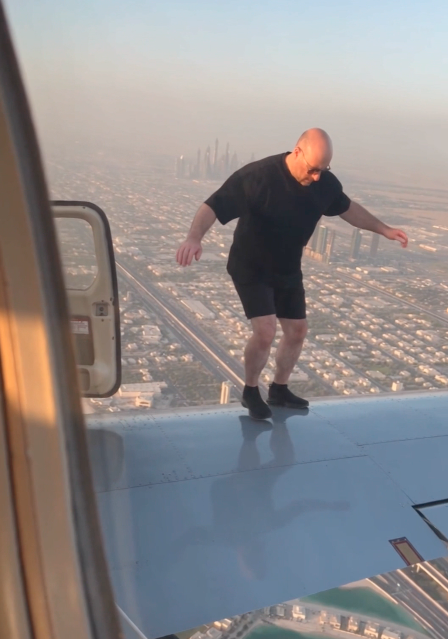
@image1 = absolute visual authority for CHARACTER + WARDROBE.
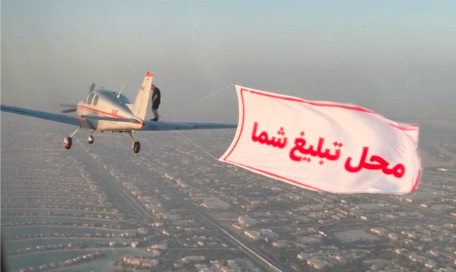
@image2 = absolute visual authority for the PRINTED ADVERTISING ARTWORK on the towed banner.
Keep the references completely separate:
@image1 controls only the person.
@image2 controls only the banner artwork.
CHARACTER
Use @image1 as the exact identity reference. Preserve face, facial proportions, skin tone, hairstyle, body proportions, clothing, footwear and accessories. Do not beautify, redesign, smooth, stylize or reinterpret the person. The same real person from @image1 must remain recognizable throughout. No face drift, body transformation, wardrobe change or duplication.
TWO-AIRCRAFT GEOMETRY — ABSOLUTE RULE
There are ALWAYS exactly TWO separate aircraft.
AIRCRAFT A = filming aircraft.
AIRCRAFT B = subject aircraft carrying @image1 and towing @image2.
The camera is physically INSIDE AIRCRAFT A for the entire video.
@image1 is physically INSIDE / ON AIRCRAFT B.
The camera and @image1 are NEVER on the same aircraft.
AIRCRAFT A and AIRCRAFT B fly side-by-side in parallel formation, in the same direction, at nearly the same speed, about 40–60 meters apart.
There is ALWAYS open air between the camera and AIRCRAFT B.
Even during close shots, the camera remains physically 40–60 meters away. Close framing is created ONLY by strong DIGITAL SMARTPHONE ZOOM.
AIRCRAFT A never approaches AIRCRAFT B.
The camera never enters AIRCRAFT B.
@image1 never enters or exits AIRCRAFT A.
If a window edge is visible near the camera, it belongs ONLY to AIRCRAFT A.
@image1 exits ONLY from AIRCRAFT B and performs the entire stunt ONLY on the wing of AIRCRAFT B.
AIRCRAFT B must remain the SAME SMALL AIRCRAFT from beginning to end.
Never transform AIRCRAFT B into:
- a passenger airliner
- commercial jet
- large airliner
- different aircraft
- another wing or fuselage
AIRCRAFT B
Use one consistent realistic small aircraft throughout. Preserve fuselage geometry, wing shape, tail, cockpit/windows, real side door/access opening, engine/propeller configuration, landing gear and paint scheme.
No aircraft morphing, redesign or duplication.
ADVERTISING BANNER
AIRCRAFT B physically tows a LARGE rectangular lightweight fabric banner behind it for the entire flight.
The banner exists from the beginning, but it must remain COMPLETELY OUTSIDE THE CAMERA FRAME until AFTER the backflip and landing.
Use @image2 as the EXACT printed artwork on the banner.
Do NOT generate, type, OCR, translate, redraw, recreate, improve or respell any Persian text inside @image2.
Treat @image2 as ONE finished image already professionally printed onto the fabric.
Use @image2 itself as a fixed printed texture.
Preserve exactly:
- Persian lettering already inside @image2
- all dots and letter shapes
- red color
- white background
- red rounded border
- spacing
- composition
- orientation
Do not mirror, reverse, crop or replace @image2. Do not add text, logos, numbers, symbols or watermarks.
The printed side faces the filming aircraft and camera.
The banner aspect ratio should closely match @image2 so the artwork is not stretched or cropped.
BANNER PHYSICS
The banner is attached behind AIRCRAFT B by a realistic tow cable.
It trails naturally behind the aircraft and reacts to airflow with tension, subtle rippling, edge flutter, small folds and turbulence.
@image2 bends WITH the fabric as a physical print, but the CONTENT of @image2 never changes.
The banner is NOT a digital screen, hologram, floating graphic, rigid billboard or camera overlay.
LOCATION
High above a large modern coastal metropolis in bright midday daylight. Far below: city blocks, roads, rooftops, bridges, coastline and distant skyscrapers. Clear blue sky with realistic atmospheric haze.
CAMERA
ONE CONTINUOUS UNBROKEN TAKE.
The smartphone is handheld by a passenger inside AIRCRAFT A, filming sideways through its side window toward AIRCRAFT B.
No cuts.
No transitions.
No orbit.
No fly-around.
No switching aircraft.
No camera teleportation.
No rear chase shot.
No tail-following shot.
No external camera mount.
AIRCRAFT B is viewed mainly from a true side profile.
Camera behavior:
- imperfect handheld shake
- subtle aircraft vibration
- small natural framing corrections
- slight delay when re-centering
- occasional subject drift
SMARTPHONE LOOK
Authentic modern iPhone footage:
- aggressive HDR
- slight over-sharpening
- deep focus
- digital noise
- compression artifacts
- slight window reflections
- rolling-shutter jello
- atmospheric haze
- heat shimmer
- visible degradation during strong digital zoom
No cinematic depth of field.
No polished commercial look.
No movie color grading.
FLIGHT MOTION
Both aircraft continuously move forward through real air.
AIRCRAFT B naturally drifts slightly, bobs vertically, rolls subtly and vibrates.
If it has a propeller, it remains a fast translucent spinning disc.
The open door/hatch shakes strongly in the airflow.
The background must show realistic aerial parallax; the city below moves faster than distant skyline and horizon.
TIMELINE
0.0–3.5s — TIGHT TELEPHOTO SIDE VIEW / EXIT
Start ALREADY strongly digitally zoomed toward @image1 on the SEPARATE AIRCRAFT B.
The camera is still physically inside AIRCRAFT A, 40–60 meters away.
AIRCRAFT B is seen ACROSS OPEN AIR.
This must NEVER look like the camera is inside AIRCRAFT B.
The tight frame shows:
- @image1
- the real side opening of AIRCRAFT B
- part of AIRCRAFT B fuselage
- part of AIRCRAFT B wing
Do NOT show the full aircraft.
Do NOT show the tow cable.
Do NOT show the banner.
Do NOT show any part of @image2.
@image1 exits the real side opening of AIRCRAFT B, carefully places one foot and then the second onto the wing, and rises to standing.
Hair, clothing and accessories react naturally to the wind.
Operator quietly says:
“oh my god… oh my god…”
3.5–6.5s — WALK ALONG THE WING
Keep the camera digitally zoomed in from AIRCRAFT A.
AIRCRAFT A and B remain 40–60 meters apart.
Do NOT move the camera closer.
Do NOT switch aircraft.
Do NOT reveal banner or tow cable.
@image1 carefully walks several steps outward along the SAME wing of AIRCRAFT B. Arms extend for balance. Each step has clear contact with the wing. The body reacts naturally to wind, turbulence and aircraft vibration.
The character stops, plants both feet, bends knees and moves arms backward to prepare.
6.5–8.5s — EXACTLY ONE BACKFLIP
Keep the camera close.
The banner and tow cable remain completely outside frame.
@image1 performs EXACTLY ONE complete standing backflip on the wing:
jump upward → knees tuck → backward rotation → fully inverted → exactly one 360° rotation → body opens → both feet descend toward the SAME wing.
Fast and athletic. No slow motion.
PHYSICS:
@image1 already shares AIRCRAFT B's forward velocity before jumping and retains it during the flip. AIRCRAFT B must NOT fly away underneath them. The character stays approximately above the same section of wing.
No hovering.
No weightlessness.
No teleportation.
No invisible support.
No freefall away from the aircraft.
No jumping from an airliner.
Operator suddenly shouts:
“OH MY GOD!”
The phone shakes harder from the reaction.
8.5–10.5s — LANDING
@image1 lands on BOTH feet on the SAME wing of AIRCRAFT B.
Knees compress deeply. The character briefly overbalances, swings arms outward, recovers and crouches. One or both hands briefly touch the wing.
The landing has believable human weight.
Keep the camera close for a short moment after landing.
The banner is STILL NOT visible.
The tow cable is STILL NOT visible.
10.5–13.5s — DIGITAL ZOOM-OUT / BANNER REVEAL
ONLY NOW begin a gradual DIGITAL ZOOM-OUT from AIRCRAFT A.
AIRCRAFT A does NOT physically move backward.
AIRCRAFT B does NOT change aircraft type or position suddenly.
Reveal progressively:
@image1 on wing
→ more of SAME wing
→ more of SAME small AIRCRAFT B
→ complete SAME AIRCRAFT B
→ realistic tow cable
→ LARGE @image2 advertising banner
This is the FIRST time the viewer sees the banner.
The reveal should feel surprising and intentional.
The exact @image2 image is visibly printed across the fabric surface.
Do NOT generate the Persian writing. Use @image2 itself as the fixed printed image.
The banner ripples naturally but remains open enough to clearly recognize:
- white background
- red rounded border
- exact Persian artwork from @image2
13.5–16.0s — WIDE SIDE PROFILE / BANNER HERO MOMENT
Remain wide enough to clearly show:
@image1 + SAME SMALL AIRCRAFT B + tow cable + @image2 banner.
The banner gets a clear visual hero moment.
AIRCRAFT A continues flying parallel beside AIRCRAFT B.
The banner trails naturally behind AIRCRAFT B with realistic aerodynamic motion.
@image1 stays on the same wing and begins carefully moving back toward the fuselage.
AIRCRAFT B may begin a gentle believable bank away near the end, while the camera operator follows slightly late.
Do NOT introduce a third aircraft.
Do NOT transform AIRCRAFT B into a passenger jet.
Do NOT move the camera onto AIRCRAFT B.
End like authentic amateur smartphone footage.
AUDIO
Authentic smartphone microphone recording from inside AIRCRAFT A:
- aircraft engine
- cabin and wind noise
- mechanical vibration
- microphone buffeting
- occasional clipping
- natural breathing
Dialogue only:
Beginning:
“oh my god… oh my god…”
During flip:
“OH MY GOD!”
After landing:
natural shocked laughter.
No narrator.
No music.
No cinematic sound design.
CONTINUITY LOCK
@image1 remains the exact same character throughout.
AIRCRAFT B remains the exact same SMALL aircraft throughout.
AIRCRAFT A remains the separate filming aircraft throughout.
@image1:
- exits ONLY from AIRCRAFT B
- stays on the SAME wing of AIRCRAFT B
- performs exactly ONE backflip
- lands on the SAME wing
- never enters AIRCRAFT A
The banner:
- physically exists from 0.0s
- is attached ONLY to AIRCRAFT B
- remains outside frame until after landing
- uses the exact @image2 artwork
- never changes spelling, colors or layout
- never mirrors or reverses
- never becomes blank
- never becomes a screen
- never detaches
FINAL GEOMETRY LOCK — HIGHEST PRIORITY
CAMERA = inside AIRCRAFT A.
@image1 = on AIRCRAFT B.
AIRCRAFT A ≠ AIRCRAFT B.
They NEVER become the same aircraft.
There is ALWAYS open air between camera and @image1.
The camera NEVER enters AIRCRAFT B.
@image1 NEVER exits AIRCRAFT A.
@image1 NEVER jumps from a passenger airliner.
AIRCRAFT B remains the SAME SMALL AIRCRAFT for the entire video.
The late banner reveal is achieved ONLY by DIGITAL ZOOM-OUT from AIRCRAFT A.
NO aircraft transformation.
NO commercial passenger jet.
NO third aircraft.
NO camera teleportation.
NO aircraft switching.
FINAL @image2 RULE
@image2 is a FINISHED IMAGE, not a typography instruction.
DO NOT generate Persian text.
USE @image2 ITSELF AS THE PRINTED IMAGE ON THE FABRIC.
Only the physical fabric may ripple, bend, flutter or change perspective.
THE VISUAL CONTENT OF @image2 MUST REMAIN UNCHANGED.